1. Introduction
For the ultimate in capacity and recycle time, get a high-voltage flash battery in the Quantum Turbo line.
Since I last wrote about the Quantum Turbo battery line in 2006, Quantum has continued to improve the line and add new models.
There are now five models to choose from in the Turbo line. My new favorite is the Quantum Turbo SC (Slim Compact). Weighing in at just under a pound, it's 60% lighter than the original Turbo Battery. Read on to learn how the Turbos can help your flash photography.
2. Powering Your Flash
Every photographer who uses a hotshoe flash eventually longs for one thing—fast recycle times between shots. We also want a power supply that gives us plenty of shots before it has to be recharged or replaced.
There are several options for powering your hotshoe flash: AA alkaline batteries, AA rechargeables, and various external flash batteries. For the ultimate in capacity and recycle time, get a high-voltage flash battery like those in the Quantum Turbo line (www.qtm.com).
Understanding power options
Alkaline batteries are readily available, but their recycle times (the time it takes to charge the flash for the next shot) are relatively long; they just can't supply energy fast enough. What's worse, from the first shot, your recycle time goes slowly and inexorably downhill. And if you shoot a lot of full power flashes, alkalines run out pretty quickly—and many end up in landfills polluting the environment.
Nickel Metal Hydride (NiMH) cells are a significant improvement—the recycle times are shorter, and remain constant (until the batteries suddenly run out and have to be recharged). But their capacity is limited (although better than alkalines), and if you're using a lot of flash power you can still wait several seconds between shots—which can be an eternity when shooting fast-breaking action.
Rechargeable Nickel-Cadmium (NiCd or NiCad) batteries are older technology, and have been largely supplanted by NiMH cells, which don't suffer from memory problems (loss of capacity if recharged before fully drained). I would always choose Nickel Metal Hydride over NiCad.
In addition to the above batteries that fit inside the flash, you can choose from various types of external batteries or power sources. These break down into two types:
- low-voltage (6 volt) batteries like the Quantum Battery 1 or Quantum Battery 2
- high-voltage (300+ volt) batteries like the Quantum Turbos
Both of these can provide you with much greater shooting capacity. But only the high-voltage source will give you dramatically faster recycle times. There's only one catch: your flash must have a high-voltage socket designed to work with the high-voltage battery.

Figure 1. Photographing penguins in the Falkland Islands.
Workshop participant Rock mounted his Quantum Turbo 2x2 Battery to his tripod using the QBC Mounting Clamp. The power cable connects to the Canon 550EX Speedlite, which is mounted off-camera on a Really Right Stuff Flash Arm. A Better Beamer Flash Extender increases the range of the flash for the Canon 300 mm f/2.8 IS lens.
Low-voltage battery packs replace the four AA batteries inside your flash. A plastic insert fits inside your flash battery compartment and connects via cable to the external battery. These batteries can give you a lot more shots—their capacity is limited only by their size and weight. But because they give you the same voltage as four alkaline cells—six volts—they won't do much to improve recycle times. To understand why, let's look at how an electronic flash works.
3. Stop that Whining!
When a flash recycles, the power source, whether AA cells or an external battery, must charge a capacitor—an electrical "holding tank"—by filling it with electrons. When you fire the flash, those electrons are released suddenly into a flash tube filled with xenon gas, which emits a brief but brilliant flash of light. The recycle time is the time it takes to refill that electrical holding tank (capacitor) so it will be ready for the next shot.
Charging that capacitor actually requires a fairly high voltage inside the flash—about 300 volts or more in your typical hotshoe flash. If your power source consists of four 1.5 volt AA batteries, however, you're starting with 6 volts, which needs to be boosted to 300.
How do you get from 6 volts to 300? By whining. That high-pitched whine you hear as your flash recycles comes from an oscillator circuit that dutifully boosts the power to 300 volts. But that voltage conversion takes time. And if you've discharged the flash completely (shooting at a distant subject, for instance), you can wait a painfully long time for that Ready Light to come back on. Your flash won't be the only one whining.
The high voltage advantage
The solution? Start with a high-voltage power source, and feed it directly into the flash. You bypass the oscillator, the long recycle times, and the whining. That's what Turbos are designed for. Their 300+ volt output flows quickly and directly into your flash, giving you super-fast recycle times even with full power flash output.
Not all flashes are designed to accept this high voltage source, but most higher-end hotshoe flashes will. You can check with Quantum (www.qtm.com) to be sure your flash is compatible with a Turbo, and to find the proper power cable for your flash. (Compatible flashes have a high-voltage socket, often hidden behind a removable cover; refer to your flash manual.)
If your flash has no provision for high voltage input, you can still select from a range of 6 volt external battery packs offered by Quantum and others. These will provide many more flashes on a single charge than AA cells—but you won't get the fast recycle times that high voltage packs provide.
It's worth noting that these batteries put out so much power that you can actually damage your flash if you're not careful. That can happen if you fire your flash at full output twenty or more times in rapid succession, without letting it cool. Don't get carried away in the heat of the moment.
Assuming your flash—and you—can handle this power, what are the pros and cons of the models in Quantum's Turbo lineup?
Table 1. Specifications
Name/
Model |
Street
Pricea |
Weight
|
Volume,
Dimensions |
Battery
Type |
Turbo
QTB |
$389 |
2.4 lb.
1,100 g |
46 cu. in.
6.7 x 4 x 1.7 in. |
Lead-acid |
Turbo 2x2
T2x2 |
$550 |
2.0 lb.
900 g |
45 cu. in.
6.2 x 4 x 1.8 in. |
NiMH |
Turbo C (Compact)
TC |
$404 |
1.0 lb.
450 g |
27 cu. in.
5.5 x 2.2 x 2.2 in. |
NiMH |
Turbo SC (Slim Compact)
TSC |
$430 |
0.97 lb.
442 g |
24 cu. in.
5.14 x 3.6 x 1.3 in. |
NiMH |
Turbo AC
TAC |
$419 |
1.8 lb.
792 g |
27 cu. in.
5.5 x 2.2 x 2.2 in. |
AC power |
aStreet prices on September 25, 2009 (B&H Photo)
4. Common features
The batteries in the Turbo line will all give you many more flashes and much faster recycle times than AA cells (see Table 2). All the Turbos feature a power monitor "fuel gauge" to let you know how much charge remains, and require an accessory cable designed for your flash. The included AC charger for all models is universal voltage compatible ( 100-240 volts AC), great for overseas travel. (Note that chargers are not interchangeable among models.)
Table 2. Performance comparisona
| Model |
Sockets |
Recycle
(sec.) |
Capacity
(Flashes) |
Charging
(hr.) |
| Turbo |
1 |
1 |
500 |
4 |
| Turbo 2x2 |
2b |
1 |
700 |
3/1.5 |
| Turbo C |
2c |
1.4 |
400 |
1.5 |
| Turbo SC |
1 |
1.4 |
400 |
1.5 |
| Turbo AC |
2c |
1.3 |
unlimited |
N/A |
| AA alkaline |
- |
10 |
75 |
- |
aPerformance for typical hotshoe flash at full flash power. Data provided by Quantum Instruments. bCan power 2 flashes, or 1 flash and 1 camera. cCan power 1 flash and 1 camera.
5. Turbo SC and Turbo C: New and Compact
The Turbo SC Slim Compact ($430) is one of the newest Turbos in the Quantum line. With a weight of 1 pound each, it's less than half the weight of the Turbo (2.4 lb.) and Turbo 2x2 (2 lb.), and about 40% smaller (see Table 1). It doesn't recycle quite as fast as its larger siblings (1.4 versus 1 second, after flashing at full-power). But if size and weight are important, and you don't need the absolute fastest recycling, it's a winner. And despite its compact size, Turbo SC still provides 400 full-power flashes, compared to 500 for Turbo and 700 for Turbo 2x2 (Table 2). Recharge time is a fast 1.5 hours.
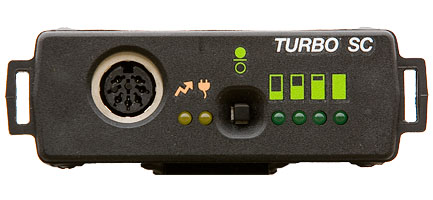
Figure 2. Quantum Turbo SC.
As its name suggests, the Turbo SC Slim Compact is a slimmed down version of the larger Turbos, and it readily fits into a decent-sized pocket. You can also clip it onto your belt (and it's not as likely to make your pants fall down as the 2.4 pound Turbo!), or attach a shoulder strap.
The Turbo C ($404) is as light as the Turbo SC, and shares its performance specs, but it's shaped differently. It's designed to attach to the bottom of your camera by screwing into the tripod socket. With your flash mounted on your camera's hotshoe, the Turbo C creates a single camera-flash-battery unit, useful for handheld shooting. You may find this more convenient than being tethered to your camera and flash via a Turbo cable with a battery in your photo vest or clipped on your belt. (More than once I've set down my camera in the heat of action and begun to walk away with Turbo in pocket, only to be abruptly yanked back by the cable; fortunately, I've always stopped before doing any more damage.)
To clip the Turbo C onto your belt, you'll need the optional Quantum Multi Clip QMC ($10). You can connect this accessory to the Mounting Clamp QBC an mount the Turbo C on a tripod leg or pole.
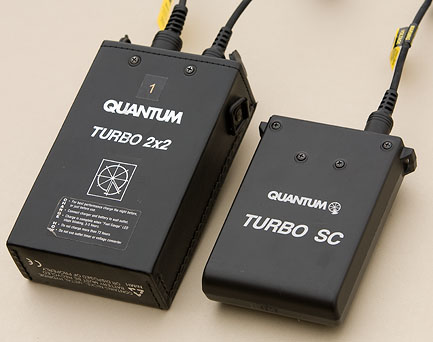
Figure 3. Quantum Turbo 2x2 and Turbo SC side by side.
6. Turbo 2x2: Big, with Power to Spare
If you need the fastest recycle times or greatest capacity, consider the Quantum Turbo 2x2 ($550). Although it's the same size as the original lead-acid Turbo, the lighter Nickel Metal Hydride cells in the 2x2 provide a lighter battery with almost twice the capacity.
The Turbo 2x2 has two sockets, so it can power two flashes (or a flash and a digital camera). The Turbo 2x2 was released when digital cameras were relatively new, consumed a lot of power, and came with batteries that didn't power a lot of shots. At that time it was a real advantage to have an external power source for your digital SLR. From my perspective, this is no longer necessary, as the efficiencies of cameras and their batteries have improved dramatically.
On the other hand, if you're using more than one flash, the second socket is a nice feature. I have several Turbo 2x2 batteries and find them invaluable for powering the multiple flashes I use for hummingbird photography.
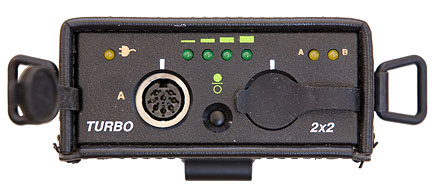
Figure 4. Quantum Turbo 2x2.
One of the two flash sockets is shown protected by the built in covers. A single pushbutton switch turns the battery on and off, and a fuel gauge shows the power remaining. A shoulder strap can be attached to the D-rings, or the battery can be mounted using the built-in belt-clip (bottom).
Note: Quantum sells the Dual Power Connector QT48 (a bit pricey at $78), a splitter cable that lets you power two flashes from one socket. For hummingbird photography, flashes are set manually to very low power, and I've run four flashes (at 1/16 power) using one Turbo 2x2 with two QT48 connectors. Quantum doesn't recommend powering more than two flashes per Turbo—and I wouldn't do this with flashes set to full power—but I haven't had problems with my low-power flashes this way.
Another advantage of the second socket is that, if you have another charger, you can recharge your Turbo 2x2 with one charger in each socket, cutting the recharge time down to 1.5 hours, compared to 3 hours with a single charger. Sweet!
The Turbo 2x2 has a belt clip that also attaches to the Mounting Clamp QBC for mounting on a tripod leg or pole.

Figure 5. Rainbow-bearded Thornbill, Ecuador.
The beautiful iridescence of hummingbirds is really enhanced with fill flash. During two days of waiting at 11,000 feet in the Andes of Ecuador, this stunning bird only visited our workshop group for a total of about two minutes. Canon Speedlite 550EX-II with Better Beamer Flash Extender, powered by Quantum Turbo 2x2. Canon 500 mm lens on EOS 1D Mark II. Exposure 1/500 sec. @ f/5.6, ISO 800.
7. Turbo Battery: the Original Turbo
The original Quantum Turbo Battery ($389) was for many years the battery of choice for many a photojournalist or nature shooter who needs the ultimate in recycle time and capacity. The Turbo is powered by sealed lead-acid cells, so you don't have to worry about leakage. These have proved quite reliable (they eventually wear out and can be replaced by Quantum factory service). Like NiMH cells, they are memory-free, meaning you can recharge them at any time, even if you've only run them down a little, with no loss in capacity.

Figure 6. The original Quantum Turbo Battery
The Turbo can be placed in a large photo vest pocket, and also has two D-rings for an optional shoulder strap; it also has a belt clip that connects to the Mounting Clamp QBC. But at 39 oz. this is the heaviest of the Turbo line.
Previous Turbos shipped with a single-voltage charger (115 V in the U.S., other voltages elsewhere). That meant you had to buy another charger if you traveled to a country with different voltage. (Note: You should not plug a charger into the typical travel voltage converter; these converters produce a "dirty" current that can damage electronics.) Quantum tells me that newly manufactured Turbos are shipping with the universal voltage (100-240V AC) Charger QT52. Check with your supplier to see which charger is in the box. If you have an older single-voltage charger and need to travel, you can purchase the Charger QT52 ($55).
Turbo AC for AC power
If you use a lot of hotshoe flash in a studio or anywhere you can shoot tethered to AC power, the Turbo AC might be right for you. Not a battery, it is essentially an AC power source for your flash (with high-voltage socket) and/or camera. It provides a fast 1.3 second recycle time, and you have unlimited power while connected to an AC outlet. It mounts directly to your camera's tripod socket, or to a tripod leg or pole using the optional Mounting Clamp QBC.
Turbo Z—discontinued
If you're looking for used Turbos, you might come across the Turbo Z, which Quantum discontinued a few years ago. It used NiCad cells, which were prone to memory problems that caused them to lose capacity. In order to guard against this, you had to fully discharge the battery before recharging it, which could be a hassle. I'd recommend against a used Turbo Z because of their old and troublesome NiCad technology.
8. Do I Still Need AA Batteries with Turbo?
You might think that you can dispense completely with the four AA batteries in your flash when you use a Turbo but, alas, that is usually not the case. Those AA batteries are still needed to power the electronics of your flash. This includes powered zooming, wireless transmitters and receivers, exposure functions and the display.
Most modern flashes won't function at all without batteries installed, even when powered by a Turbo. Quantum supplies a "Battery Saver," which is the same size as a AA battery. The idea is to substitute this for one of the four AA batteries,and thereby draw less power from these cells. You can experiment with this. In practice, I've found it doesn't work with a lot of flashes if you're using "electronics-intensive" features like wireless flash. For that reason, I generally put a fresh set of NiMH AA cells in the flash each day—and I often find that they are substantially drained at the end of the day if I'm using wireless TTL.
Your flash may still draw partly on the AA batteries to recycle the flash, even with a Turbo. (That's the problem the Battery Saver is supposed to fix.) Newer flashes (e.g., Canon Speedlite 580EX) have a Custom Function you can set that tells the flash an external power source is being used, and to only use the internal cells for the electronics. This helps prolong the life of the AA batteries.
9. In the Field
I frequently use my Turbos in conjunction with a long telephoto lens on a tripod and a Fresnel lens Better Beamer Flash Extender. The Better Beamer (which I've used for a long time and now sell in our online store) focuses the light from your flash into a narrow beam, perfect for telephoto lenses. Because the flash output is more concentrated, your flash will go farther, and you'll use less power. Combined with a Turbo battery, your recycle times will be quite short, especially for fill flash (which uses less power than full flash). I've saved many a wildlife shot with fill on an overcast day, by adding some color and that all important catchlight in the eyes. Fill flash can also reduce harsh shadows.

Figure 7. Semipalmated Sandpiper, Nome, Alaska.
This foraging Semipalmated Sandpiper paused just long enough for this shot. Fill flash adds light to the shadows on the belly and breast. Canon Speedlite 550EX with Better Beamer Flash Extender, powered by Quantum Turbo 2x2. Canon 500 mm lens with 1.4X extender on EOS 1D Mark II. Exposure 1/1250 sec. @ f/5.6, ISO 250.
Mounting options
The original Turbo, Turbo 2x2, and Turbo SC have D-rings for attaching the optional Quantum Shoulder Strap QB60 ($26) or another strap of your choice, and also have a built-in belt clip. The Turbo C battery and AC-powered Turbo AC attach to the base of your camera using its tripod socket. You can also mount them on your tripod leg or a lightstand using the Quantum Mounting Clamp QBC ($37). The Turbo C requires the optional Quantum Multi Clip QMC ($10) to do this; it also serves as a removable belt clip.
Unless you're shooting handheld, I highly recommend the Mounting Clamp QBC. This C-clamp screws onto the leg of your tripod and has a slot for clipping on the battery. I attach the QBC Clamp to the metal piece above the carbon fiber leg of my Gitzo tripod; otherwise it's possible to crack the carbon fiber if you over-tighten the clamp.)
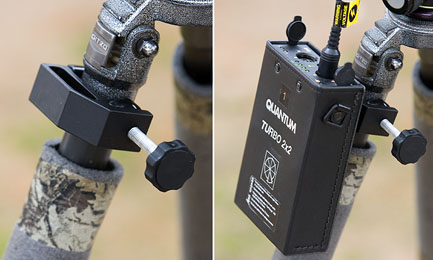
Figure 8. Quantum Mounting Clamp QBC; with Turbo 2x2 on tripod leg (right).
The Mounting Clamp QBC conveniently mounts your Turbo battery to a tripod leg or lightstand. Here I've mounted it on the metal tube of my Gitzo tripod, just above the carbon fiber leg, to avoid putting too much force on the carbon fiber. The Turbo attaches via its belt clip.
Vehicle chargers
For most of these models, Quantum offers vehicle chargers that plug into your car's accessory socket. You can charge the original Turbo from a vehicle with the QT46 charger, but a full charge takes 6-12 hours. For the Turbo SC and Turbo C, you'll need the Quantum TCV charger (charging time not specified). At the time of writing, there is no vehicle charger for the Turbo 2x2, but Quantum tells me one is in the works.
Flash overheating
It's worth emphasizing that these Turbos have so much power that you can damage your flash by overheating if you fire off a lot of full-power flashes as fast as you can.
A Canon service rep once told me that Canon doesn't "officially" recommend the use of Turbos (or any other product that doesn't have the Canon name on it, for that matter); but he acknowledged that many people use them without problems. I have used them for years without incident. But occasionally, one of my workshop participants will get carried away in the heat of the moment and, with motor drive blazing, will burn out his flash, necessitating a trip to the service center.
This may be a case where, "The light that burns twice as bright, burns half as long" (Blade Runner). Or, as Peter Parker's gentle Uncle Ben tells him, "Remember, with great power comes great responsibility" (Spiderman). In any case, caveat emptor.
Replacing cells
Eventually, the cells in your Turbo will wear out with extended use, and you'll notice that the capacity has diminished significantly after a full charge. You can send in your Turbo and Quantum will replace the cells ($86 for original Turbo, $96 for the other models. Check with Quantum for current rates: www.qtm.com.). I've been pleased with their service.
NiMH self-discharge—charge the night before
One shortcoming of many NiMH batteries, including those in the new Turbos, is that they slowly lose their charge while sitting on the shelf (or in your camera bag). This takes place over days and weeks. If your NiMH Turbos—or any NiMH batteries— have been sitting unused, you should charge them a day or two before you need them. (New NiMH technology produces cells that don't self-discharge, but this type of cell has not made its way into the Turbo line yet.)
The original Turbo is different, because of its lead-acid cells. Quantum recommends topping it off after every use and storing it fully charged. Also, after three months of no use, you should take it out, fire off a few flashes, and fully charge it.
Rain and moisture
Quantum makes no claim about Turbos being water resistant or sealed. And the high internal voltages will wreak havoc if water gets inside; salt water is orders of magnitude worse than fresh water. (This is true of your camera and flash as well.) So you'll want to take precautions to keep your Turbos and flashes from getting wet.
I've used various Turbo batteries in rain (with an improvised cover), and in high humidity situations such as tropical rain forests, without any problems. I take the same precautions I use to protect my camera gear.
I was drenched (and knocked to the ground) by a rogue wave in the Falkland Islands while photographing Rockhopper Penguins. That was the end of my Turbo for the duration of the trip (as well as my flash; Canon 500 mm f/4 lens; 1.4X converter; and one week old EOS 1D Mark II). But everything was repaired and restored to good-as-new condition once I returned home.
10. Recommendations
High voltage power sources will give you plenty of flashes and the fastest recycle times, and Quantum offers several excellent products in this arena with its Turbo line.
- The Turbo SC Slim Compact provides a lot of power in a small, lightweight package. Its Nickel Metal Hydride technology supplies almost as many flashes as the original lead-acid Turbo, but with a 60% reduction in weight. For use with big lenses, mount it to your tripod with the Mounting Clamp QBC. If you do a lot of hand-held shooting, you might prefer the Turbo C Compact which mounts directly to the bottom of your camera.
- The Turbo 2x2 almost doubles the capacity of the SC with even faster recycle times, but at double the weight. But it's still lighter than the original lead-acid Turbo, with twice the capacity. It tops my list for heavy-duty flash shooting. And its two sockets are a plus when using more than one flash. Mount it to your tripod with the Mounting Clamp QBC.
- If you don't mind the weight, the original Quantum Turbo Battery has stood the test of time and is still a great performer; it recycles your flash as fast as the newer Turbo 2x2, and faster than the Turbo SC and Turbo C. Its lead-acid battery won't self-discharge the way NiMH cells do on the shelf, an advantage if you need a battery that you can grab on a moment's notice.
I started with the original Turbos, and now have two Turbo 2x2's and the lightweight Turbo SC. I've been very satisfied with their performance. I hope this information helps you to supercharge your flash photography!

Figure 9. Bluethroat, Nome, Alaska.
Fill flash helped bring out the colors in this beautiful Bluethroat, a favorite target bird for on the Seward Peninsula around Nome, Alaska. Canon Speedlite 550EX with Better Beamer Flash Extender, powered by Quantum Turbo 2x2. Canon 500 mm lens with 2X extender on EOS 1D Mark II. Exposure 1/800 sec. @ f/11, ISO 640.